Xiangwei Zhang张向伟
I joined Tencent Security Yunding Lab in 2024 as a senior security researcher. Most of my work is finding vulnerabilities: I have found and reported bugs in browser engines, network protocol parsers, and AI infrastructure, and have been acknowledged by Apple, Google, Microsoft, Amazon, Meta, NVIDIA, Mozilla, and others. I work with the offense and defense team on exploit development, and on attack-surface assessments of internal products such as Tencent Meeting and QQ Browser. I also worked on the eBPF host-monitoring plugin for Onion, Tencent’s host intrusion detection system, covering on the order of a million hosts. I now work on capability development for CodeBuddy Security, Tencent’s AI code security audit platform. I studied at Tianjin University from 2017 to 2024 (B.S. and M.S.), advised by Prof. Junjie Wang, fuzzing JavaScript engines and WebAssembly compilers.
Background
Experience and education
2024.04 — present
Senior Security Researcher
Tencent Security Yunding Lab
AI code auditing: CodeBuddy Security
2025.12 — present- Designed and built VulnAgent, a vulnerability-discovery agent: intelligence scopes the search, the agent audits module by module, an independent pass reviews, and a PoC in a sandbox confirms. The first version ran end to end within two weeks.
- Turned VulnAgent into the AI deep-audit engine of the CodeBuddy Security platform: batch orchestration and concurrency, multi-round audits that converge without repeating, external intelligence input, incremental diff review, and automated PoC verification.
- 16 public CVEs found with it, in React, NVIDIA Megatron-LM, Apache IoTDB, Suricata, FreeRDP, LiteLLM, and others. On a benchmark that scores recall of historical CVEs in well-known open-source projects, it reached 73.2% end to end.
Vulnerability research and red-team support
2024.08 — 2025.12- Built a generation-based WebAssembly fuzzer and ran it against JavaScriptCore, V8, and SpiderMonkey: CVE-2024-54508 (WebKit), CVE-2025-1933 (Firefox), and further JSC and V8 bugs reported to the vendors.
- Worked with the offense and defense team: turned public browser n-days into reliable exploits across dozens of versions, and found and weaponized vulnerabilities in widely used desktop clients for red-team exercises.
- Attack-surface assessments of internal products such as Tencent Meeting and QQ Browser, and of LLM applications, AI code sandboxes, and MCP tool chains during offense and defense exercises, with hardening guidance delivered to the product teams.
- Adapted and shipped C/C++ rules for the in-house static analysis platform and worked down false positives during rollout. Patch analysis and fuzzing of network protocol parsers in this period became the starting point for VulnAgent.
Host intrusion detection and cloud security
2024.04 — 2025.04- Worked on development of the eBPF host-monitoring plugin for Onion, Tencent’s host intrusion detection system. I took over testing and tuning of the DNS query monitor and added container attribution, built the TCP scan-behavior monitor that ties scans to the originating process, and wrote YARA rules for common proxy tools and their variants.
- Ran the plugin’s staged rollout and release monitoring; it now runs on the order of a million hosts.
- Security testing of cloud host and network agents: found command injection, SQL injection, and arbitrary file upload issues, and helped the owning teams fix them.
2017 — 2024
B.S. and M.S.
Tianjin University
Software security, advised by Prof. Junjie Wang. Fuzzing for JavaScript engines and WebAssembly compilers: PatchFuzz and WasmCFuzz, and a contribution to FuzzJIT.
Featured project
CodeBuddy Security
Vulnerabilities
Selected CVEs
Major vendors involved, all confirmed and fixed: Apple · Meta · NVIDIA · Mozilla · Apache · OISF.
React · Web
Denial of service in React Server Components.
WebKit · Client
Out-of-bounds read. Crafted web content can crash the process. Fixed in Safari 18.2 and the corresponding Apple system updates.
Firefox · Client
JIT corruption of WebAssembly i32 return values on 64-bit CPUs, found by fuzzing. Leftover bits can make a value be treated as a different type.
Suricata · Network and protocol
Type confusion in DNS-over-HTTP/2, an invalid free that can lead to remote code execution.
FreeRDP · Network and protocol
Heap buffer overflow in the clipboard virtual channel. A malicious RDP server can gain code execution.
NVIDIA Megatron-LM · AI infrastructure
Remote code execution by loading a malicious file.
Apache IoTDB · Web
Expression injection through the JEXL evaluator.
LiteLLM · AI infrastructure
SQL injection.
Gitea · Web
Argument injection in an external renderer, leading to remote code execution.
Langflow · AI infrastructure
Path traversal in bulk delete.
Research
Publications
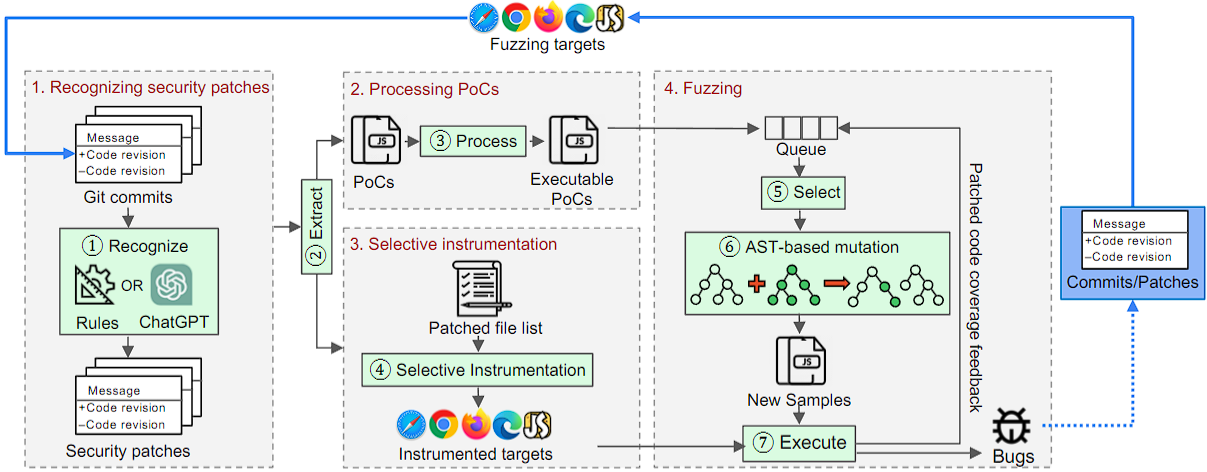
- PatchFuzz: Patch Fuzzing for JavaScript Engines
Information and Software Technology, vol. 194, 2026
Journal article 108087. Preprint: arXiv:2505.00289.
Workflow diagram
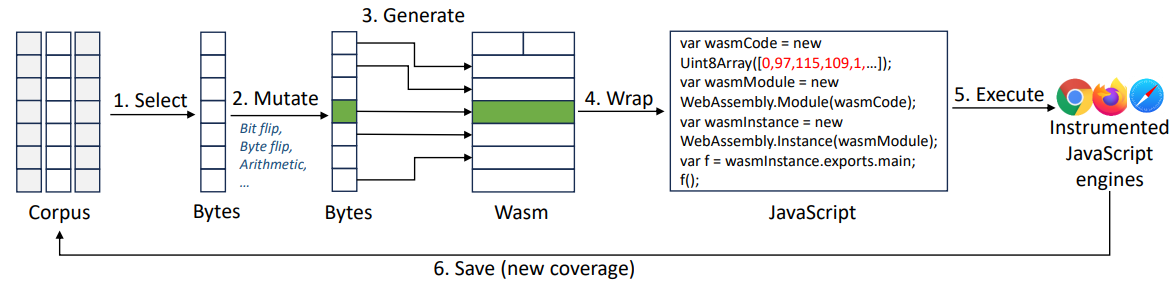
- WasmCFuzz: Structure-aware Fuzzing for Wasm Compilers
EnCyCriS/SVM '24, pp. 1–5
Proceedings of the 2024 ACM/IEEE 4th International Workshop on Engineering and Cybersecurity of Critical Systems (EnCyCriS) and 2024 IEEE/ACM Second International Workshop on Software Vulnerability
Workflow diagram
- An Empirical Study on AST-level Mutation-based Fuzzing Techniques for JavaScript Engines
Internetware 2023
Earlier research
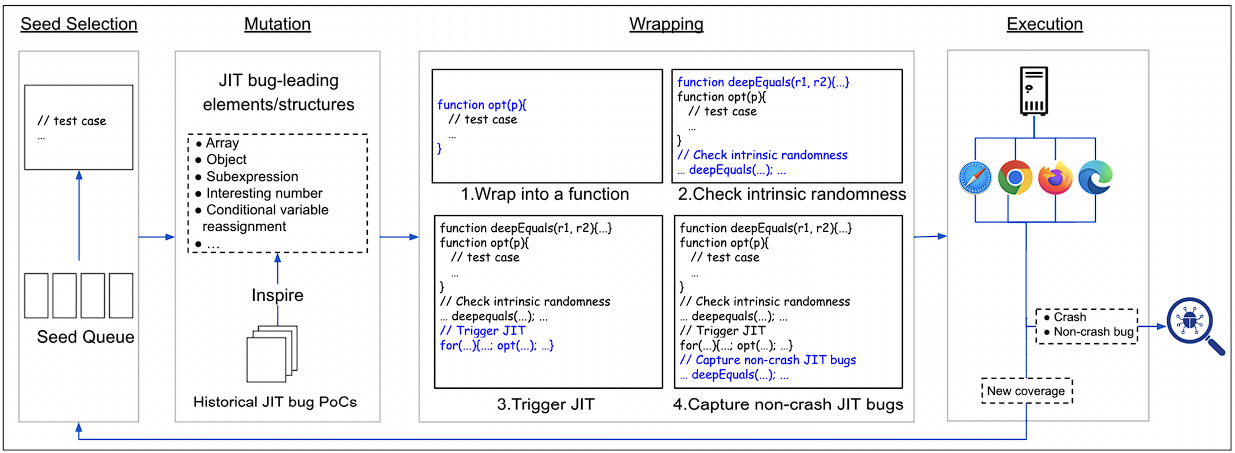
- FuzzJIT: Oracle-Enhanced Fuzzing for JavaScript Engine JIT Compiler
USENIX Security 2023, pp. 1865–1882
Authors are my advisor Junjie Wang and collaborators. I was responsible for the experimental part, and used the tool to find several bugs.
Workflow diagram